The approach
Your whole body.
Keep expanding what you can do.
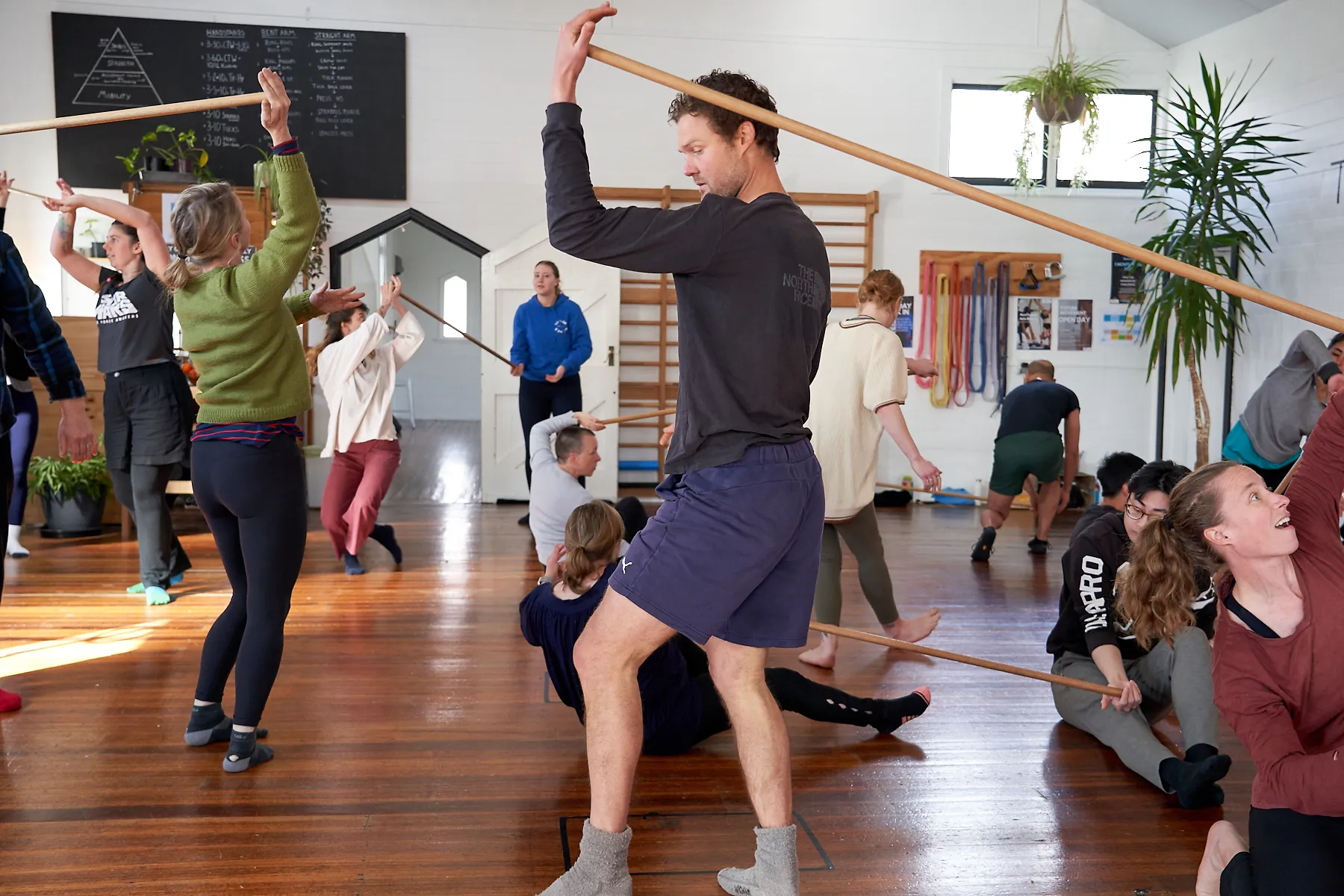
We take inspiration from calisthenics, gymnastics, dance, martial arts, locomotion, weightlifting, somatic practices and more. We believe in training that makes you fitter, gives you more ways to move, more confidence in your body, and more capacity for life.
Three kinds of practice get you there.
Build
Strength Mobility
The base: strength and mobility built together, through your body's full range.
Control
Locomotion Skills
Organising what your body can now support.
Use
Games Improvisation
Expressing it: in play, in problems, in life.
Build Strength and mobility
Small steps that hold.
Strength is built through five families, each organised as a ladder of progressions. You join at your level, working where it is difficult but doable.
The strength we do takes you through full ranges of motion, so strength and mobility grow together.
The positions you reach become positions you own: strong at the bottom of a deep squat, full-range pull-ups, dips, and beyond.
Training App
Track your progress in our app. See where you are, what comes next, and what you have already built across the core strength skills and progressions.
Bent Arm Pulling
Control Locomotion and skills
Turn strength and mobility into movement
Crawling, animal movement, balancing, rolling, cartwheels, handstands and more: all with progressions that give everyone somewhere to start.
You learn to organise your body in increasingly complex ways, building control, coordination and adaptability.
Learn through movement.
The Loop
Underneath everything we do is the same process: you feel what your body is doing, act on that information, learn something, and try again.
Rather than simply replicating shapes, you use feedback to refine how you move. How slowly can you do it? How smoothly? With how much control?
- situation the activity
- perception how it feels
- action what you do
- feedback what changed
- learning what you keep
Feel it first
Your job is to feel, not to fix.
The better you become at noticing what your body is telling you, the stronger and freer your movement becomes.
Awareness isn't separate from movement. It is the basis of it.
Use Games and Improvisation
Serious practice. Serious fun.
Games are where we turn something we practice into something we use. When you can reach for a movement spontaneously, you know you own it.
Games are fun, add complexity, and push you beyond predictable movement. They reveal what you can do, what breaks down, and what to build next. It is the loop at live speed.
Play isn't a break from practice. It's one of its purest forms.
The whole practice.
- Strength & Mobility
- The base. A core ladder of progressions, one small step at a time, tracked in the app.
- Locomotion & Skills
- Paths for every level, guided by the quality of your movement.
- Games & Improvisation
- Solving puzzles, having fun, and expressing what you have built.
What we're really building
A body you can trust.
Strong enough, mobile enough and adaptable enough to handle the unexpected. Hiking, surfing, getting down on the floor with your kids and back up again, for decades.
What you'll gain.
- Greater strength and mobility
- Better movement quality and coordination
- Greater awareness of yourself and your movement
- More confidence in your body
- A body prepared for sport, work and everyday life
- A movement practice that grows with you