
Library
The Story of the Human Body
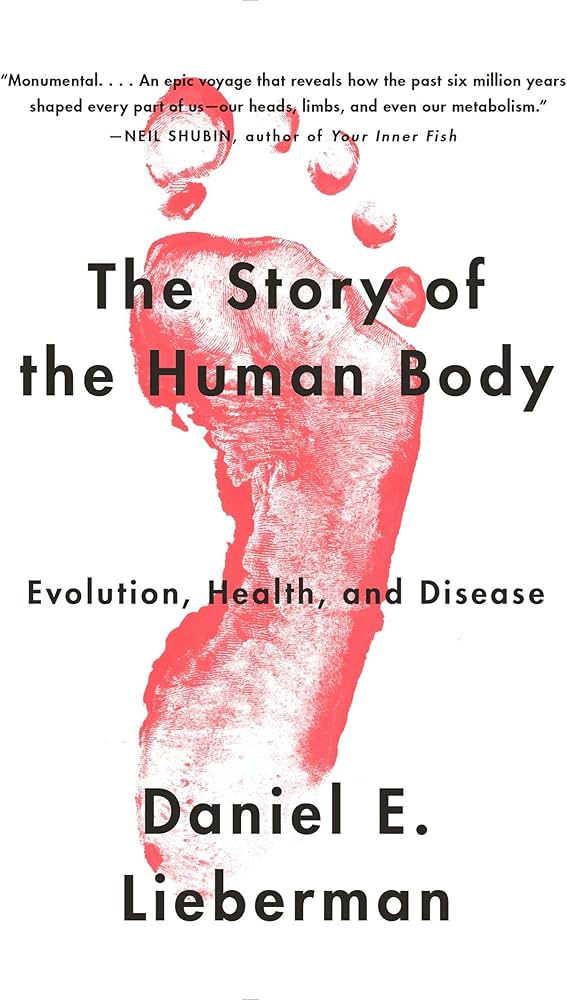
A deep look at human evolutionary biology and the mismatch between the environments we evolved in and the ones we live in now. The best explanation I know for why varied, natural movement matters for health.
For Anyone curious about why the human body needs regular, varied movement to stay healthy
The Story of the Human Body explores the evolution of the human body and how our species came to be shaped by the environments and lifestyles of our ancestors. Drawing on evolutionary biology, anthropology, and human physiology, Daniel Lieberman examines how our bodies evolved to move, eat, reproduce, and survive, and what happens when the environments we live in change faster than our biology can adapt.
I find the book fascinating because it provides a broader context for understanding evolutionary health and the idea of evolutionary mismatch. Many of the health problems we experience today are not simply the result of individual choices, but can be understood, at least in part, through the mismatch between the environments our bodies evolved in and the environments we now inhabit.
Our ancestors lived in environments that demanded regular movement, physical variability, strength, endurance, and interaction with an often unpredictable world. Modern life has removed many of these demands. We sit for long periods, move through increasingly predictable environments, and often use our bodies in relatively narrow and repetitive ways. At the same time, we are exposed to new challenges that our biology has had little time to adapt to.
Lieberman explores how these mismatches may contribute to what are called “mismatch diseases”: chronic health problems that we assume are a normal part of human existence but which actually arise when our evolved biology interacts with a modern environment in ways that it was not adapted for. This includes many of the chronic conditions associated with modern lifestyles, as well as musculoskeletal problems such as back pain.
For people interested in movement, this offers a deep perspective on the idea of evolutionary movement health. If our bodies evolved in response to a constantly changing physical environment, then health may not simply come from exercising for an hour each day. It may also come from restoring some of the movement demands and variability that our modern environments have removed: walking, carrying, climbing, squatting, balancing, running, reaching, hanging, playing, and continually adapting to different physical challenges.
I particularly appreciate how Lieberman does not propose that we need to recreate the lives of our ancestors or that there is one ideal way of moving. Rather, his ideas encourage us to ask better questions about what kinds of movement experiences the human body is adapted to, and whether our modern environments provide enough of them.
For me, the book reinforces the idea that movement is not simply something we do to improve our health or fitness. Movement is one of the fundamental forces that has shaped the human body. Understanding our evolutionary history can help us understand why movement matters, how modern life may create mismatches with our biology, and how we might create environments that allow the human body to thrive as individuals and as a community.